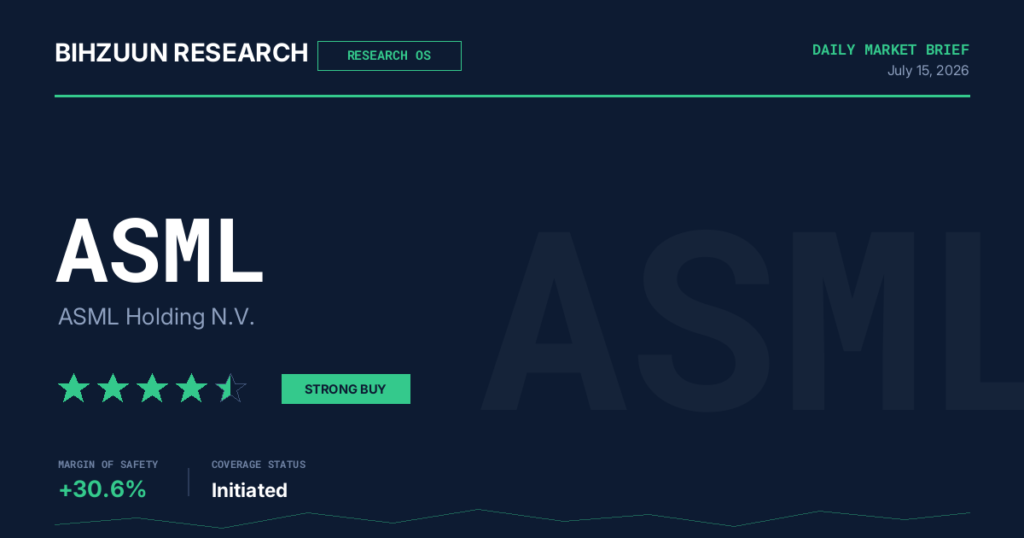
Bihzuun Research — Institutional Equity Report
ASML Holding N.V. (NASDAQ: ASML) — July 15, 2026
| Ticker | Exchange | BRS Rating | Target Price | Current Price | Margin of Safety | Timeframe | Prior Coverage |
|---|---|---|---|---|---|---|---|
| ASML | NASDAQ / Euronext |
★ ★ ★ ★ ★ Strong Buy |
$2,318 (DCF base case) | $1,775.64 | ~30.6% (trend: declining) | 12–18 months | 2 screens since 2026-07-14; passed both |
1. Business Overview & Economic Moat
Corporate Profile
ASML Holding N.V. is the world’s sole manufacturer of extreme ultraviolet (EUV) lithography systems — the capital equipment without which advanced semiconductor fabrication at sub-5nm process nodes is physically impossible. Headquartered in Veldhoven, the Netherlands, ASML operates across the full lithography stack: system sales, installed base management (field upgrades, service contracts), and a rapidly scaling High-NA EUV product line that represents the industry’s next critical production enabler. The company generated $32.67 billion in revenue in the most recent fiscal year and this morning reported Q2 2026 results materially ahead of consensus, with full-year 2026 guidance raised to €43–45 billion — a ~16% upward revision at the midpoint that unambiguously resets the forward earnings model.
Moat Architecture: Three Reinforcing Layers
- Technological Singularity: ASML commands 100% market share in EUV lithography. Nikon and Canon exited the technology over a decade ago; no credible industrial-scale alternative exists. Each EUV system costs up to $400 million, weighs approximately 180 tons, and requires roughly 100,000 components from an ecosystem ASML has spent decades assembling and qualifying. This is not a market where a well-capitalised entrant can replicate capability within a product cycle.
- Installed Base Flywheel: H1 2026 net service and field option sales grew 28.1% year-over-year to €5.25 billion. This recurring, high-margin revenue stream — structurally insulated from the lumpiness of new machine orders — is the moat’s most underappreciated dimension. As the cumulative EUV installed base expands, the service revenue line becomes a compounding annuity that elevates earnings quality and reduces cyclical sensitivity at the operating income level.
- High-NA EUV Pricing Step-Up: Each High-NA EUV system commands 2–3× the price of a standard EUV unit. Intel Foundry’s achievement of mass production logic using High-NA EUV — a milestone CEO Christophe Fouquet described as “proof of the maturity of the tool” on today’s earnings call — directly validates the commercial viability of this next-generation platform. Samsung and SK Hynix are expected to follow into volume ramp during 2027–2028, establishing a multi-year average selling price tailwind that supports gross margin expansion well beyond ASML’s already exceptional current levels.
Strategic Positioning in the AI Infrastructure Cycle
Big tech capital expenditure commitments exceeding $400 billion in 2026 AI infrastructure are not abstractions for ASML — they are orders. TSMC’s 2nm node is reportedly fully booked for 2026, and ASML has disclosed that it is approaching full subscription of its 2027 EUV order book while already accumulating a large volume of 2028 bookings. The AI capex supercycle converts ASML from a cyclical capital equipment supplier into something closer to a regulated infrastructure utility — one that happens to grow its pricing every product generation. ASML’s 2030 revenue ambition of €44–60 billion implies a high-single-digit topline CAGR, with margin expansion as High-NA EUV displaces a growing share of the mix.
2. Financial Deep Dive
Income Statement Quality
| Metric | Value | Bihzuun Commentary |
|---|---|---|
| Revenue | $32.67 billion | Elite scale for a capital equipment manufacturer; comparable to major software platforms in revenue density |
| Net Income | $9.61 billion | 29.4% net margin — structurally supported by monopoly pricing and high-margin service mix |
| Q2 2026 Revenue (reported today) | €9.33 billion | Beat consensus of €8.80 billion; management confirmed both sales and gross margin above guidance |
| Q2 2026 Net Income | €2.92 billion | Above consensus of €2.62 billion; Basic EPS of €7.59 |
| FY2026 Revenue Guidance (raised) | €43–45 billion | Prior: €36–40 billion. ~16% midpoint raise reflects structural AI-driven demand acceleration |
| Q3 2026 Sales Guidance | €11.0–12.0 billion | Substantial sequential step-up; gross margin guidance of 55–57% signals continued pricing discipline |
| EPS | $24.73 | Basis for dividend policy and capital return framework |
| BRS Financial Quality Score | 100 / 100 | Perfect score; reflects margin profile, ROIC discipline, and earnings predictability |
| BRS Growth Score | 100 / 100 | EUV volume growth + High-NA ASP uplift + installed base compounding = sustained multi-year growth visibility |
Balance Sheet & Capital Allocation
| Metric | Value | Bihzuun Commentary |
|---|---|---|
| Equity Base | $19.6 billion | Supports 49.0% ROE — exceptional capital efficiency for the asset intensity implied |
| Return on Equity | 49.0% | Sustained by monopoly pricing power; not a leverage artifact — long-term debt is modest |
| Long-Term Debt | $2.71 billion (12.1% of capital structure) | Retirable within approximately one quarter of net earnings; balance sheet conservatism is genuine |
| Dividend Yield | 0.49% | Intentionally modest; retained earnings strategy is coherent given the reinvestment opportunity set |
| Payout Ratio | 35.5% | Disciplined; preserves capital for R&D and capacity scaling without constraining shareholder returns |
| BRS Balance Sheet Score | 85 / 100 | Strong; modest deductions reflect intangible-heavy asset base and customer concentration dynamics |
| BRS Income Score | 12 / 100 | Reflects low yield and growth-oriented payout policy; income investors are structurally misaligned with this name |
3. Multi-Model Valuation Assessment
Composite Intrinsic Value Framework
Valuation is the central analytical tension in this report. ASML is a business of exceptional and demonstrable quality — every financial metric confirms this — but quality and price are different variables, and their divergence here is significant. The multi-model composite produces a median intrinsic value of $459.49 against a current market price of $1,775.64, implying a composite negative margin of safety of 74.1%. The BRS Valuation Score of 0 / 100 reflects this quantitatively. However, the model range is wide, and the interpretation of that range carries the analytical weight of this section.
| Model | Output | Interpretive Note |
|---|---|---|
| DCF Base Case (12–18 month target) | $2,318.30 | Most defensible upside scenario; sits above current price and anchors the formal target. Reflects robust near-term cash flows. Confidence: ~40% |
| DCF Sensitivity Range | $2,194 – $2,447 | Under optimistic assumptions, stock appears fairly valued at the upper bound; under base case, ~30% upside |
| Comparable Company Model | $609.84 | Peer-relative anchoring; penalises the monopoly premium that is structurally justified in ASML’s case |
| Earnings Power Value (EPV) | $309.13 | Static earnings power; no credit for growth optionality — analytically honest but incomplete for a compounder |
| Graham Number | $167.55 | Academic at this price level; book-value-anchored metrics are structurally inapplicable to asset-light monopolies |
| Dividend Discount Model | Collapsed | Dividend growth assumptions exceed discount rate — a technical signal that the market embeds extraordinary long-duration growth expectations |
| Composite Median | $459.49 | Mechanically derived; the wide dispersion across models is itself informative — conventional anchors fail to price a monopoly compounder |
Valuation Interpretation: Growth Optionality vs. Current Earnings Power
The $1,315 gap between the DCF base case ($2,318) and the composite median ($459) is not analytical noise — it represents the market’s explicit pricing of High-NA EUV adoption, AI-driven capex acceleration, and ASML’s 2030 revenue ambition of €44–60 billion. The DCF model earns its primacy in this framework because it is the only methodology that incorporates the temporal value of ASML’s structural demand drivers. Today’s guidance raise to €43–45 billion for FY2026 — a 16% midpoint revision — materially strengthens the DCF’s input assumptions, which had been calibrated on the prior €36–40 billion range. In effect, the Q2 2026 earnings print narrows the execution risk premium embedded in the DCF scenario, modestly increasing confidence in the $2,318 target.
The margin of safety trend — 30.7% declining to 30.6% — signals that price appreciation has marginally outpaced fundamental earnings upgrades on a trailing basis. Investors initiating positions at current levels are implicitly underwriting flawless execution on EUV volume ramp, High-NA commercialisation, and sustained AI capex. That is a concentrated bet on a manageable but non-trivial set of outcomes. We address this forthrightly in the Risk section below.
4. Competitive & Industry Analysis
Lithography: A Market Structure With No Parallel
The competitive landscape in EUV lithography is, by the most rigorous definition, a monopoly. Applied Materials, Lam Research, and KLA are formidable operators in adjacent equipment categories — deposition, etch, and metrology respectively — but none has a meaningful pathway into lithography. These companies compete for semiconductor manufacturer capex allocations in aggregate, but they do not compete with ASML for lithography share. The correct competitive frame for ASML is not market share within an industry; it is the durability of the industry’s dependence on ASML’s specific technology.
China: Domestic Alternatives and the Timeline Gap
The most frequently cited competitive threat — China’s domestic lithography development program — does not constitute a near-term commercial risk. The most advanced Chinese prototype is not projected to reach production readiness until 2028–2030 at the earliest, and even upon reaching that milestone, it would trail ASML’s current EUV capability by a significant generation gap. Critically, ASML is not standing still: the company’s roadmap targets a 50% increase in chip production throughput per EUV tool by end of decade, expanding the capability gap even as Chinese development programmes accelerate. The relevant competitive risk from China is therefore geopolitical and regulatory — discussed in depth in the Risk section — rather than technological displacement.
High-NA Adoption: TSMC’s Deferral and the Intel Offset
TSMC’s Senior Vice President Kevin Zhang has confirmed no plans for High-NA EUV adoption before 2029, citing cost economics. This is the most material near-term headwind to High-NA volume ramp assumptions. However, the analytical response to this disclosure requires differentiation: TSMC’s deferral shifts the adoption mix, not the adoption trajectory. Intel Foundry is already in mass production using High-NA EUV — CEO Fouquet described this as “proof of the maturity of the tool” in this morning’s call — and Samsung and SK Hynix are committed to High-NA ramp in 2027–2028. The addressable revenue pool from Intel, Samsung, and SK Hynix alone is sufficient to sustain a meaningful High-NA contribution to ASML’s 2027–2028 revenue model, with TSMC providing incremental upside when its own economics justify the transition. Critically, ASML’s capacity planning for 2027 — adding approximately 30% EUV capacity versus 2026 — reflects management’s forward visibility on the non-TSMC customer base.
Industry Structure: AI Capex as a Structural Demand Floor
The semiconductor equipment industry is cyclical by historical characterisation, but the AI infrastructure supercycle is introducing a structural demand floor that modifies that characterisation for leading-edge equipment specifically. Big tech’s $400+ billion in 2026 AI infrastructure investment creates a multi-year pull-through for TSMC’s most advanced nodes, which in turn creates a sustained demand signal for ASML’s EUV tools. ASML’s disclosure of near-complete 2027 order book subscription and substantial 2028 order accumulation provides explicit evidence that this floor is translating into bookings, not merely sentiment. Cross-referencing the Catalyst Monitor section: Broadcom’s Q3 FY2026 earnings on September 3 — with $16 billion in AI semiconductor revenue guided — will serve as the next third-party data point confirming the durability of this capex regime.
5. Risk Mapping
Risk Register
| Risk Factor | Probability | Severity | Bihzuun Assessment |
|---|---|---|---|
| China Export Controls — MATCH Act Escalation | Medium-High | High | China fell from 36% of Q4 2025 net system sales to 19% in Q1 2026 following initial export restrictions. The MATCH Act — a bipartisan bill that would ban DUV exports to China and require allied alignment within 150 days — represents the structural escalation risk. The installed base servicing prohibition within the Act is the underappreciated dimension: it threatens ASML’s high-margin China service revenue, not merely new system shipments. The US Affiliates Rule suspension until November 10, 2026 creates a binary regulatory calendar risk; any early reinstatement constitutes an unscheduled earnings shock. Separate allegations from Commerce Secretary Lutnick regarding potential EUV system diversion to China — denied by ASML — add headline and reputational risk to the regulatory vector. |
| Valuation Multiple Compression | Medium | High | At 38–40× forward P/E, ASML’s valuation embeds extraordinary long-duration growth expectations. Any macro or earnings development that causes the market to discount those expectations — a hawkish Fed surprise, a tech sector multiple re-rating, or a guidance miss — would produce a disproportionate drawdown relative to the fundamental earnings impact. The margin of safety trend (30.7% → 30.6%) signals incremental deterioration; investors are paying a higher proportion of fundamental value for every incremental dollar of stock exposure. |
| Semiconductor Capex Cyclicality | Low-Medium | High | While AI infrastructure investment provides a structural demand floor, the broader semiconductor capex cycle remains a risk. A macro-induced correction in enterprise IT spending or a sharp inventory correction at logic or DRAM customers could defer orders and compress near-term revenue recognition. The Q2 guidance raise meaningfully reduces the probability of this scenario materialising in the near term but does not eliminate the medium-term risk. |
| High-NA Yield Qualification & Ramp Delays | Medium | Medium | ASML plans to ship 60 low-NA EUV tools in 2026 (25% increase versus 2025) while simultaneously qualifying High-NA tools across fabs with differing process architectures. Yield qualification delays at customer fabs extend revenue recognition timelines. This is not a competitive position risk — ASML’s moat is unaffected — but it introduces earnings timing volatility that could disappoint markets accustomed to precision guidance delivery. |
| Macro Regime & Rate Sensitivity | Medium | Medium | The FOMC meeting on July 29, the Q2 GDP advance estimate on July 30, the August 7 nonfarm payrolls report, and the August 12 CPI print form a concentrated macro event corridor in the weeks immediately following this publication. The Fed funds rate has been held at 3.50%–3.75% for four consecutive meetings, with the June dot plot shifting toward a potential hike. The risk channel is second-order: higher rates compress technology multiples rather than directly impairing ASML’s financial model. A deteriorating labor market with sticky inflation — stagflationary signal — would be the worst-case macro regime for ASML’s premium valuation. |
| TSMC High-NA Deferral Impact | Confirmed | Low-Medium | TSMC has confirmed no High-NA EUV adoption before 2029, citing cost economics. This shifts High-NA volume assumptions toward Intel, Samsung, and SK Hynix for 2027–2028. The risk is real but bounded: ASML’s 2027 order book is nearly full from the non-TSMC customer base, suggesting the volume displacement is manageable. TSMC’s eventual adoption — required for sub-2nm competitive parity — remains a long-dated upside option, not a lost revenue stream. |
| Geopolitical Allegations & Reputational Risk | Low-Medium | Medium | US Commerce Secretary Lutnick’s inquiry into whether an ASML EUV system may have reached China in breach of export restrictions introduces regulatory and reputational complexity. ASML denies the allegations. Resolution in ASML’s favour would be a non-event; adverse findings could trigger additional restrictions or compliance burdens that constrain operational flexibility. |
6. Catalyst Monitor
| Date / Window | Catalyst | Direction | Analytical Significance |
|---|---|---|---|
| Today — July 15, 2026 | ASML Q2 2026 Earnings (Reported This Morning) | Positive — Resolved | Revenue of €9.33B beat €8.80B estimate; net income of €2.92B beat €2.62B estimate; FY2026 guidance raised to €43–45B from €36–40B (~16% midpoint increase). Intel High-NA production milestone confirmed. The primary near-term catalyst has resolved strongly in favour of the bull thesis. |
| July 29, 2026 | FOMC Rate Decision | Macro Risk / Watch | Fed funds rate held at 3.50%–3.75% for four consecutive meetings; June dot plot signals potential hike. A hawkish surprise compresses ASML’s 38–40× forward P/E multiple. Second-order impact on tech capex appetite. Elevated monitoring priority given proximity to earnings reset. |
| July 30, 2026 | Q2 2026 GDP Advance Estimate | Macro Risk / Watch | Weak print combined with a hawkish Fed would form the most adverse near-term macro signal for ASML’s valuation multiple. Context: June nonfarm payrolls came in at a weak +57K. |
| August 7, 2026 | July Nonfarm Payrolls | Macro Risk / Watch | Continuation of weak labor market signals could accelerate rate cut probability — positive for high-multiple growth stocks — or trigger stagflation concerns if accompanied by sticky CPI. August 12 CPI print provides the inflation side of that binary. |
| August 12, 2026 | CPI Data Print | Macro Risk / Watch | Inflation trajectory is the critical variable shaping whether the Fed can ease without reigniting price pressures. Benign print = positive for ASML multiples; sticky or upside surprise = hawkish risk. |
| November 10, 2026 | US Affiliates Rule Suspension Expiry | Regulatory Risk — Binary | The current suspension of the Affiliates Rule expires. Reinstatement would expand the scope of China export restrictions to include servicing of existing equipment — a direct threat to ASML’s high-margin installed base revenue in China. This is a hard calendar risk requiring active monitoring. |
| September 3, 2026 | Broadcom Q3 FY2026 Earnings | Positive Read-Through / Confirmation | Broadcom has guided $16 billion in AI semiconductor revenue for the quarter. A strong print confirms that hyperscaler AI infrastructure capex — the ultimate demand driver for ASML’s order book — remains durable and not plateauing. Cross-references directly to ASML’s backlog visibility. |
| Q4 2026 / Q1 2027 | ASML Q3 & Q4 2026 Earnings | Positive — Pending | Q3 2026 guidance of €11.0–12.0B revenue implies a substantial sequential acceleration. These prints will determine whether the FY2026 guidance raise was conservative or whether further upward revision is possible. Key metrics: High-NA system shipment count, installed base revenue growth rate, and China revenue as a percentage of system sales. |
| June 10, 2027 | ASML Capital Markets Day | Positive — Structural Re-Rating Event | ASML will revisit its 2030 revenue model assumptions (currently €44–60B). Post-Q2 demand visibility — near-complete 2027 order book, substantial 2028 bookings, High-NA Intel production milestone — will likely inform a structurally higher long-run framework. This is the catalyst with the greatest potential for a durable multiple re-rating, as opposed to earnings momentum. |
| 2027–2028 | Samsung / SK Hynix High-NA EUV Ramp | Positive — Sequential Revenue Uplift | Mass production adoption of High-NA EUV by Samsung and SK Hynix drives ASP uplift and gross margin expansion. Each High-NA system at 2–3× standard EUV pricing represents a step-change in per-unit economics. Qualification timelines at these fabs are the primary execution variable to monitor. |
7. Investment Verdict
Synthesis: The Quality-Price Paradox
ASML presents institutional investors with an investment case that is analytically honest only when its internal tension is explicitly acknowledged rather than resolved in either direction through motivated reasoning. The business is, by every measurable dimension of financial quality, among the finest in global public equity markets: 29.4% net margins, 49.0% ROE, near-complete monopoly in a market that is structurally indispensable to the AI infrastructure supercycle, a growing annuity revenue stream via installed base management, and a next-generation product line (High-NA EUV) that extends the pricing power moat for at least a decade. The Q2 2026 earnings print, reported this morning, validates the bull case with exceptional clarity: revenue beat, net income beat, a ~16% midpoint guidance raise, and the Intel High-NA production milestone removing the single most cited execution overhang in the bear case.
Against this, the valuation picture demands intellectual honesty. The composite median intrinsic value of $459.49 sits 74% below the current market price. The DCF base case of $2,318.30 — the only model that adequately credits ASML’s growth trajectory — implies approximately 30% upside from current levels under conditions of flawless execution, with ~40% confidence. Current buyers are paying almost entirely for future growth optionality and are exposed to a meaningful drawdown if execution falters, macro conditions deteriorate sharply, or China regulatory risks escalate beyond current assumptions. The margin of safety trend, declining from 30.7% to 30.6%, provides a quantitative signal that price appreciation has incrementally outrun the fundamental upgrade cycle.
The BRS rating of 4.5 Stars (Strong Buy) reflects the totality of this picture: the business quality, moat durability, and catalyst visibility justify a constructive posture, while the Bihzuun Research Rating of Strategic Long — Execution-Conditioned frames the appropriate investor posture. ASML is not a name for passive or valuation-sensitive mandates at these levels. It is a name for investors with a structural view on AI infrastructure capex durability, tolerance for premium valuation, and sufficient conviction in ASML’s monopoly economics to underwrite the execution scenarios the DCF requires. Position sizing should reflect the asymmetry: the upside is substantial and grounded in genuine earnings power, but the path to realising it admits no operational margin for error.
BRS Rating & BRR Posture
| Dimension |
|---|