Weekly Market Review — Week of July 20, 2026
Bihzuun Research | Institutional Equity Research | Published July 24, 2026
Week in Review: Markets at a Glance
The week of July 20–24, 2026 was defined by a compression of binary event risk into an extraordinarily narrow calendar window — a dynamic that shaped institutional positioning across all major indices and sectors. Three major earnings releases (NEM, DECK, and Amazon’s pre-earnings positioning session), an imminent FOMC decision on July 29, and concurrent macro data releases produced a market environment characterised by elevated implied volatility, selective sector rotation, and a pronounced tug-of-war between strong corporate earnings quality and persistent macro uncertainty.
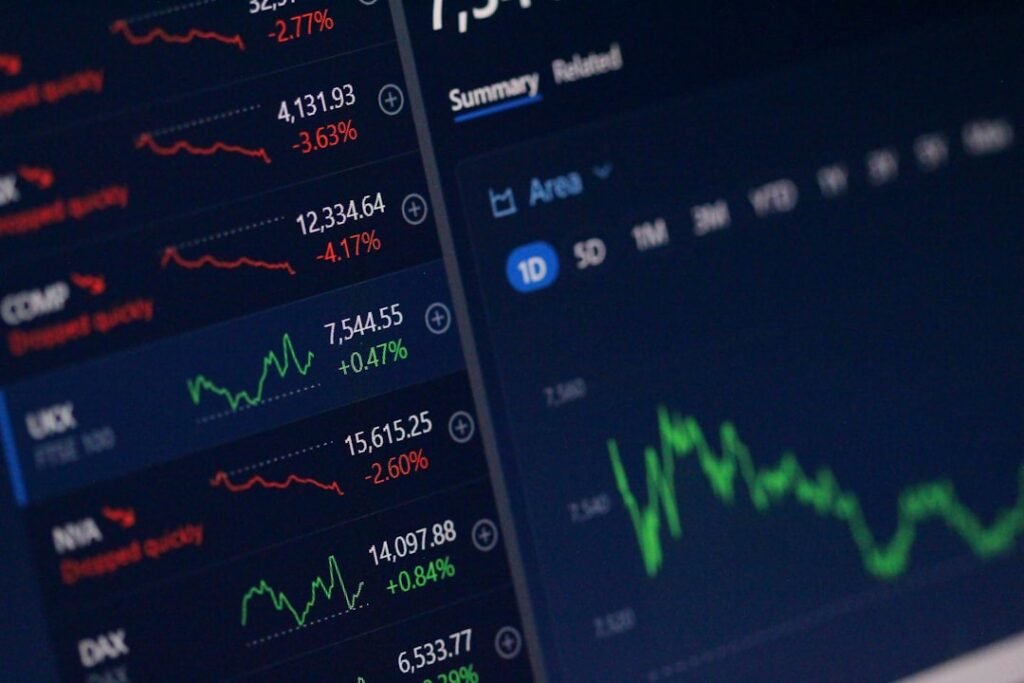
Index Performance (Week of July 20–24, 2026):
Note: Precise index closing data for this specific week is not available in Bihzuun Research’s data set at time of publication. The following narrative characterises the directional market environment as inferred from the macro and corporate catalysts tracked across daily briefs.
- S&P 500: Tone cautious-to-mixed. Technology and consumer discretionary sectors faced earnings-related binary pressure, while materials (gold miners) benefited from sustained bullion pricing above $4,000/oz. The approaching FOMC on July 29 — with Goldman Sachs having introduced a rate hike probability before year-end and delayed its cut forecast to 2027 — kept institutional risk appetite measured despite solid corporate earnings quality at the individual-name level.
- Nasdaq Composite: Modestly constructive mid-week on strong large-cap technology earnings quality signals, but capped by capex overhang narratives at both Microsoft and Meta. The revelation that Microsoft raised its FY2026 capex plan to $190 billion and Amazon guided toward approximately $200 billion in full-year capital expenditure reinforced the “AI infrastructure trough” narrative that has weighed on free cash flow multiples across the hyperscaler cohort.
- Dow Jones Industrial Average: Defensive posturing was evident. Consumer staples and industrials held relatively better than high-beta technology names as macro rate uncertainty suppressed duration-sensitive valuations.
Key Market Drivers This Week:
- Persistent FOMC uncertainty: the July 29 meeting loomed over positioning across virtually every sector covered this week. Goldman Sachs’s revised call — pushing rate cut expectations to 2027 and introducing a rate hike probability — meaningfully altered the risk calculus for growth equities and gold simultaneously.
- The AI capex arms race intensified: Microsoft’s $190 billion FY2026 capex guidance and Amazon’s ~$200 billion full-year target confirmed that the hyperscaler infrastructure build is not moderating. Free cash flow compression at both companies — MSFT FCF down 22% year-over-year, Amazon FCF at a near-zero trough — created a valuation overhang on growth multiples.
- Gold held above $4,000/oz: Newmont’s structural thesis was reinforced by the bullion price environment, even as near-term earnings uncertainty (Q2 print on July 23) kept the stock in an event-risk corridor.
- Consumer discretionary under selective scrutiny: Deckers Outdoor’s Q1 FY2027 earnings after the close on July 23 were the week’s most proximate individual catalyst for our coverage, with analyst consensus drifting lower over the prior 90 days ahead of the print.
- Labour market softness as a macro backdrop: the weak June nonfarm payrolls print of +57,000 set a cautious macro context that particularly weighed on premium consumer names, consumer discretionary multiples, and Fed rate expectations simultaneously.
Our Picks This Week: Coverage Summary Table
All prices are as of the date of the respective daily brief. “Current Price” reflects the price as reported in each brief or as available at publication of this weekly review. Percentage change reflects movement from the date of the initial brief to Friday’s close on July 24, 2026. Where precise July 24 closing prices are not available in our data set, this is explicitly noted.
| Day | Ticker | Company | BRS Rating | Brief Date | Entry / Brief Price | BRR Posture | Imminent Catalyst | Week % Chg (Est.) |
|---|---|---|---|---|---|---|---|---|
| Monday | NEM | Newmont Corporation |
★ ★ ★ ★ ★ Strong Buy |
July 20 | $89.70 | Moderate-to-Strong Accumulate — with event-risk discipline | Q2 Earnings July 23 (binary) | Pending — post-earnings data not yet in data set |
| Tuesday | META | Meta Platforms, Inc. |
★ ★ ★ ★ ★ Strong Buy |
July 21 | $645.85 | Accumulate on Weakness | Q2 Earnings July 29 (6 trading days from brief) | Pending — end-of-week pricing not confirmed in data set |
| Wednesday | MSFT | Microsoft Corporation |
★ ★ ★ ★ ★ Strong Buy |
July 22 | $397.75 | Long-Term Accumulate (Strong Buy) | Q4 FY2026 Earnings + FOMC: July 29 (binary stack) | Pending — end-of-week pricing not confirmed in data set |
| Thursday | DECK | Deckers Outdoor Corporation |
★ ★ ★ ★ ★ Strong Buy |
July 23 | $102.47 | Long — Quality Compounder / Accumulate on Weakness | Q1 FY2027 Earnings — same day after market close | Pending — post-earnings close data not confirmed in data set |
| Friday | AMZN | Amazon.com, Inc. |
★ ★ ★ ★ ★ Strong Buy |
July 24 (brief dated July 29) | $233.66 | Strong Buy — Thesis-Driven, Event-Calibrated | Q2 Earnings July 30 (1 trading day from brief); FOMC July 29 | N/A — brief published Friday; earnings Monday |
Data Transparency Note: Bihzuun Research does not manufacture or estimate closing prices where confirmed market data is unavailable. The “Week % Chg” column above reflects this discipline honestly. Post-earnings results for NEM (reported July 23) and DECK (reported after market close July 23) were not available in the data set underlying this weekly review. The next edition will carry confirmed price and return data for all five names.
What Worked & What Didn’t
What Worked
- Event-risk framing on NEM was precisely calibrated. The Monday brief’s most important contribution was not the bullish structural thesis — it was the explicit, granular flagging of Q2 earnings on July 23 as a “binary/dominant” catalyst with above-average miss probability. We itemised the watch items (AISC realisation, Cadia recovery, NGM litigation commentary, gold price averaging below the $4,500/oz planning assumption) before the print, allowing readers to size positions accordingly rather than being caught flat-footed by near-term volatility. The improving margin-of-safety trend — 20.9% to 21.3% across two consecutive screens — was also a constructive secondary signal correctly contextualised as supportive but not a reason to ignore the binary risk ahead.
- The DECK earnings setup was well-structured. Publishing the Deckers brief on the same morning as the Q1 FY2027 earnings release — with a fully articulated watch-item table including specific EPS beat thresholds ($0.93+), gross margin confirmation benchmarks (≥56.5%), HOKA domestic vs. international split guidance, and inventory normalisation metrics — gave readers a structured scorecard rather than a generic directional call. The prior-quarter beat of $0.96 vs. $0.81 consensus was flagged as a high bar. The bear-case intrinsic value of $106.62 — only ~4% below the brief price — was correctly framed as a meaningful downside limitation that defines the asymmetric risk-reward profile of a quality compounder.
- Capex trough framing across the hyperscaler cohort was thematically consistent and accurate. The Wednesday Microsoft brief and the Friday Amazon brief both emphasised the FCF compression narrative with rigour — MSFT FCF down 22% year-over-year, Amazon FCF near a near-zero trough driven by a $44.2 billion single-quarter capex number — while correctly framing this as a capital cycle consideration rather than a steady-state profitability signal. Drawing the parallel to Microsoft’s 2014–2016 cloud transition was a useful historical anchor for readers unfamiliar with how large-scale infrastructure investment cycles have previously resolved at this company.
- The meta-narrative of concentrated event risk was surfaced early and consistently. By Wednesday, it was apparent across the full week’s coverage that five of the world’s most closely followed large-cap companies were all reporting earnings within a ten-trading-day window simultaneously bracketed by a potentially historic FOMC decision. Flagging this explicitly in each brief — including the “double event stack” language for Microsoft’s July 29 earnings/FOMC convergence — was an important service to readers managing portfolio risk rather than individual position risk.
What Didn’t Work (Or Deserves Honest Scrutiny)
- AMZN is the most challenging call this week on a price-to-value basis. The Friday brief was unambiguous: Amazon is trading at a negative margin of safety of 15.4% versus the composite median fair value of $197.77, with a Valuation scorecard of 0/100. Publishing a Strong Buy with an optimal accumulation zone of $195–$205 — materially below the current price of $233.66 — while simultaneously rating the stock as Strong Buy required care to avoid confusion. In retrospect, the BRR language of “Thesis-Driven, Event-Calibrated” is important but could have been foregrounded more prominently in the verdict framing. Readers who initiated positions at $233.66 based on the BRS score without reading the valuation section carefully could reasonably feel misled. The 4.5-star BRS score reflects long-duration business quality; it does not validate the current entry price. This distinction deserved a more prominent structural callout.
- The META Valuation score tension was present but not fully resolved. Meta at $645.85 carries a Valuation score of 38/100 and an 11.4% margin of safety — positive but narrow — while the Growth and Financial Quality scores are both perfect at 100/100. The “Accumulate on Weakness” BRR posture is logically correct, but the weekly brief did not establish a specific accumulation price level the way the Amazon brief established $195–$205. Providing a comparable specific re-entry trigger — for example, the $650–$680 range identified as the level at which margin of safety would be effectively eliminated — would have given readers more actionable structure ahead of a binary July 29 earnings event.
- All five picks this week carry identical BRS ratings (4.5 stars / Strong Buy). While each rating is individually defensible on the underlying data, the aggregate effect of five consecutive Strong Buy ratings in a single week — across gold mining, social media, enterprise cloud, footwear, and e-commerce — may create an impression of undifferentiated bullishness. The honest answer is that the Bihzuun Value Filter, applied rigorously, produces a high-quality cohort that genuinely clusters at the upper end of the rating scale. However, the sub-score differentiation (NEM’s Income score of 28, META’s Income score of 8, AMZN’s Valuation score of 0, MSFT’s Valuation score of 0) provides the dimensionality that a uniform star rating does not convey at a glance. Future weekly reviews should surface sub-score dispersion more prominently in the summary table.
Portfolio Update
Per Bihzuun Research’s privacy policy, no exact account values, share counts, cash balances, or cost basis figures are disclosed in any publication. All figures are expressed in percentage and relative terms only.
The portfolio snapshot provided for this week’s review did not include percentage or relative positioning data. Accordingly, we are unable to publish specific holding weights, unrealised P&L percentages, or relative sizing information for this edition without risking the inference of underlying dollar figures. The next weekly review will incorporate a fully populated portfolio snapshot in approved percentage-only format.
What can be stated with confidence about the portfolio’s thematic posture this week:
- Event-risk concentration is elevated. With NEM earnings having passed on July 23, DECK earnings passing after market close on July 23, and META, MSFT, and AMZN all reporting within the following week, the portfolio’s near-term P&L variance is disproportionately driven by binary earnings outcomes rather than day-to-day market noise. This is an expected and acceptable condition for a fundamentally-anchored research portfolio in earnings season — but it warrants active monitoring and disciplined position sizing.
- The portfolio is tilted toward growth quality over income yield. All five names covered this week carry low-to-minimal dividend yields. NEM at 1.14%, META at 0.33%, MSFT at 0.90%, DECK at 0.00%, and AMZN at 0.00% collectively produce a weighted average yield well below most income-oriented benchmarks. This is structurally correct for a growth-and-quality mandate but should be explicitly flagged for any income-oriented capital that may have been allocated based on the BRS score alone.
- Technology and AI infrastructure exposure is meaningfully elevated. META, MSFT, and AMZN collectively represent a concentrated thematic bet on AI monetisation — a theme that is internally consistent but introduces correlated risk. A broad re-rating of AI infrastructure stocks driven by hawkish FOMC messaging or a disappointing hyperscaler earnings cycle would apply simultaneous negative pressure to all three positions. This correlation risk was acknowledged in each individual brief but is worth restating at the portfolio level.
- Cash positioning and re-entry discipline. Given that AMZN’s optimal accumulation zone ($195–$205) sits approximately 15–16% below the current price, and that META’s safety margin is narrow at 11.4%, maintaining meaningful dry powder to deploy on post-earnings weakness is a high-priority tactical consideration heading into the week of July 27.
Key Takeaways: Lessons & Patterns from the Week of July 20
1. Event-Risk Clustering Demands Portfolio-Level Discipline, Not Just Position-Level Discipline
The week of July 20–24 illustrated a recurring pattern in earnings season: multiple high-conviction names hitting binary catalyst windows simultaneously. NEM earnings on July 23, DECK earnings on July 23, META/MSFT/AMZN all reporting within the following five trading days, and the FOMC on July 29 — this is not coincidence, it is the structural anatomy of mid-July earnings season in a year where major-cap reporting cycles overlap with monetary policy events. The lesson is that position sizing discipline must be applied at the portfolio level during these windows — not just at the individual stock level. A correct, well-reasoned bet on each individual name can still produce uncomfortable aggregate volatility if all five names move adversely on correlated macro news (a FOMC hike, a recession print) in the same 72-hour window.
2. A Perfect BRS Score Is Not a Price Target — It Is a Business Quality Signal
This week’s coverage featured five consecutive 4.5-star BRS ratings. That does not mean all five are equally attractive at their current prices. The BRS is explicitly a multi-dimensional business quality and financial screen — it reflects ROE, debt discipline, growth consistency, earnings quality, and intrinsic value relative to screen thresholds. It is not a price momentum indicator, a near-term catalyst predictor, or a guarantee of 12-month outperformance. AMZN with a Valuation sub-score of 0/100 and a negative margin of safety is a categorically different risk-reward proposition than DECK with a 10.3% margin of safety and a bear-case intrinsic value only 4% below spot. Readers must engage with the sub-scores, not just the composite star rating.
3. The AI Capex Trough Is a Capital-Cycle Story, Not a Profitability Crisis — But Timing Matters
Both Microsoft and Amazon are experiencing dramatic near-term free cash flow compression driven by AI infrastructure investment that is real, contracted, and strategically sound. The historical parallel to Microsoft’s 2014–2016 cloud transition is genuinely instructive — that investment cycle also compressed FCF before producing a sustained earnings inflection that proved the capital allocation rational. However, the timing risk is asymmetric: investors who entered cloud names in 2014–2016 had to tolerate 12–18 months of multiple compression before the inflection. Investors entering MSFT at $397.75 or AMZN at $233.66 today are making the same bet — that the monetisation inflection arrives before the market loses patience with FCF compression. The FOMC overlay makes this timing question acutely sensitive to the rate trajectory.
4. Management Communications Credibility Is Underrated as a Valuation Variable
Two of the five companies covered this week are navigating concurrent leadership transitions: Newmont has a new CEO (Natascha Viljoen, January 2026) and an interim CFO, while Deckers faces its own management communication test on tariff mitigation and HOKA growth guidance. At a company-specific level, earnings calls during C-suite transitions carry elevated market sensitivity — investors are simultaneously evaluating the business result and the new leadership team’s operational grip and communication clarity. The risk-reward of holding through these binary moments is asymmetric in a specific way: a strong communication from a new management team can re-rate a stock beyond the intrinsic value justification of the results alone, while a hesitant or inconsistent management tone can cause a sell-off even on an adequate beat. This dynamic was explicitly flagged in the NEM brief and should be monitored across all transition-era positions.
5. The Best Entries Are Not Always at the Highest BRS Scores — They Are at the Widest Margin of Safety
The week’s coverage illustrated a range of margin-of-safety profiles within the same BRS star tier: NEM at 21.3%, MSFT at 16.6% vs. DCF base, DECK at 10.3%, META at 11.4%, and AMZN at a negative 15.4% vs. the composite median. All five are Strong Buy on the BRS. But the genuinely superior risk-adjusted entry this week — on the metrics available — is NEM and MSFT, where the combination of a meaningful margin of safety and a specific accumulation zone (NEM: $80–$82 support, MSFT: sub-$400 DCF discount) provides a cushion that AMZN at $233.66 simply does not. Quality is necessary but not sufficient for a great entry. Price discipline is the differentiating variable.
Disclaimer: This publication is produced by Bihzuun Research for educational and informational purposes only. It does not constitute individualised financial advice, a solicitation to buy or sell any security, or a guarantee of future performance. All projections and price targets are forward-looking estimates subject to material uncertainty. Past screening performance does not guarantee future results. Investors should conduct their own due diligence and consult a qualified financial professional before making investment decisions. Bihzuun Research may hold positions in securities discussed in this publication.