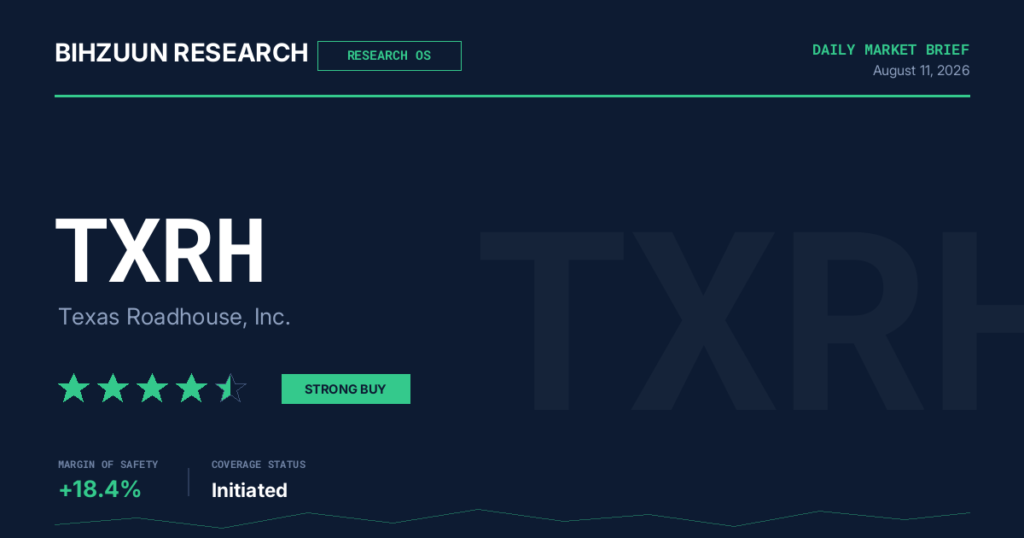
Bihzuun Research — Texas Roadhouse, Inc. (TXRH)
Institutional Equity Research | Casual Dining — Full-Service Restaurants
Summary Table
| Metric | Value |
|---|---|
| Ticker | TXRH |
| Bihzuun Research Score (BRS) | ★★★★★ Strong Buy |
| Current Price | $207.46 |
| Target Price | $220 – $245 |
| Margin of Safety | +18.4% |
| Timeframe | 12–18 months |
| BRR Posture | Constructive / Own with Discipline |
1. Business Overview & Economic Moat
Texas Roadhouse occupies the top of the U.S. casual dining hierarchy by revenue share — a position earned through structural advantages rather than mere scale. The company operates a made-from-scratch kitchen model, a distinctive hospitality culture, and, most strategically, a disciplined pricing philosophy that has become a competitive weapon in its own right.
The defining feature of the TXRH moat is its restrained menu pricing — increases held to roughly 2%, well below prevailing food-away-from-home inflation. This is not generosity; it is share capture. By keeping the value gap wide, TXRH pulls traffic from competitors who over-indexed on price hikes, translating discipline into durable traffic leadership. The result is a compounding machine: the stock has grown at approximately 17% annually over the past decade, outpacing the S&P 500.
The moat’s depth is validated by operating data (see Section 3) and by the market-share dynamics detailed in Section 5. Management’s long-duration guidance — targeting $7.4 billion in revenue and $594.2 million in earnings by 2028 — provides a credible growth runway underpinned by a robust unit-development pipeline extending into 2029.
2. Financial Deep Dive
TXRH’s financial quality is genuinely impressive and forms the backbone of its Strong Buy designation. Our scorecard awards perfect 100-point marks on both Financial Quality and Growth.
- Revenue: $5.878 billion, with net income of $406 million — a net margin near 6.9%, solid for a full-service operator navigating labor and food cost pressure.
- Return on Equity: 27.8% on an equity base of $1.461 billion — meaningful returns without excessive re-investment, the hallmark of a durable consumer brand with pricing power.
- EPS: $6.11, supporting a 1.38% dividend yield at a disciplined 46.8% payout ratio — capital returned while retaining ample reinvestment capacity.
- Balance Sheet: Long-term debt of $943 million against $1.461 billion equity yields a 39.2% debt ratio — manageable but not a fortress. Our Balance Sheet score of 51/100 reflects measured concern: serviceable, warranting monitoring should debt expand to accelerate unit growth.
- Income Profile: The Income score of 34 cautions that income-oriented investors are not well served at the current price; this is a growth-quality vehicle, not a yield instrument.
The most recent quarter reinforces the operating story: Q2 2026 revenue approached $1.7 billion, same-store sales rose 6.2% on 3% traffic growth, and average weekly sales exceeded $175,000 for the first time in the company’s 33-year history. However, the bottom line flashed caution — net income slipped 1.7% to $121.9 million as operating margin compressed from 9.7% to 8.5% year-over-year, evidence that top-line excellence is not fully insulating profitability. This margin dynamic directly connects to the commodity risk mapped in Section 6.
3. Multi-Model Valuation Assessment
Valuation is where intellectual honesty is paramount, because TXRH presents two divergent readings that must both be disclosed rather than selectively cited.
The screening figure that gated the rating: The Bihzuun Value Filter (BVF) screening margin of safety is a positive +18.4% — the figure shown in the Summary Table and the number that drives the 4.5-star Strong Buy designation.
5-Model Composite Margin of Safety: A separate multi-model composite produces a fair value of $79.91 against the $207.46 price, implying a 5-Model Composite Margin of Safety of −61.5%. These two figures diverge dramatically and cannot be reconciled away.
Why the divergence? The composite is structurally fragile:
- The DCF Declining model ($245.71) was excluded as a statistical outlier.
- The DDM Gordon Growth model broke down entirely — growth rate exceeds the discount rate.
- EPV was rendered inapplicable — an 11.4% growth rate violates its zero-growth assumption.
- Only two models survived — Graham Number ($55.01) and Comparable ($104.80) — and they disagree by 91%.
The $79.91 composite median is therefore derived from a thin, internally conflicted model set; the residual model-disagreement flag is warranted and meaningful. The most plausible interpretation is that TXRH is a high-quality compounder that static, asset- and earnings-power frameworks structurally undervalue because they cannot capture embedded brand premium, unit-growth optionality, and pricing power. The BVF methodology incorporates these dynamics more sympathetically, which explains the +18.4% reading. Investors should nonetheless recognize that the current price embeds a significant premium to conservative intrinsic-value anchors — a premium that could compress sharply under macro or margin stress.
Our base-case target of $220–$245 over 12–18 months is supportable if same-store sales hold and unit expansion stays on track; DCF sensitivity ($232–$260) offers directional support. Confidence is moderate, and this valuation uncertainty is genuinely unresolved.
4. Competitive & Industry Analysis
The battlefield is dynamic and intensifying. Two competitors matter most:
- Chili’s (Brinker): The most successful post-COVID turnaround in the sector, leading publicly traded casual dining in same-store sales growth since 2024 by competing directly with fast food at the $10 price point. Its aggressive discounting is real competitive noise but targets a more price-distressed cohort than TXRH’s core demographic.
- LongHorn Steakhouse (Darden): The more structurally threatening rival — steak-for-steak competition with comps up 5.9%, backed by Darden’s massive procurement and operational infrastructure, with pricing held ~320 bps below inflation. Darden’s synchronized multi-brand portfolio delivered 5.9% revenue and 4.2% same-restaurant sales growth in Q3 FY2026.
Crucially, a macro tailwind favors TXRH: households are rotating toward sit-down value as fast-food and fast-casual chains raised prices so aggressively they eroded their own cost advantage. As incumbent traffic leader, TXRH captures this rotation arguably better than any peer — the strategic complement to the disciplined-pricing moat described in Section 1.
5. Risk Mapping
- Commodity (primary risk — structural, not competitive): Full-year 2026 commodity inflation guidance was lowered to ~5% (from 6–7%), led by softer sirloin — a genuine sentiment catalyst. But beef remains structurally tight. Q3 inflation is guided to 2–3% before re-accelerating to ~5% in Q4, with only ~40% of the Q4 basket locked versus ~80% for Q3. This 40% unhedged Q4 exposure is the live wire in the model and directly threatens the margin trajectory flagged in Section 2.
- Margin compression: The Q2 operating margin slide (9.7% → 8.5%) confirms cost pressure is reaching the bottom line despite top-line strength.
- Valuation / multiple risk: At ~28x forward earnings, the price leaves little room for error; a macro shock could compress the multiple before H2 margin relief materializes (see Section 3).
- Execution: Balancing 35-unit 2026 expansion against unit-level economics; analysts note margin percentages declining despite steady sales and traffic.
- Regulatory: State-level minimum-wage legislation is a perennial overhang, with wage inflation guided at 3–4% for the year.
6. Catalyst Monitor
⚠ IMMINENT — WITHIN 5 TRADING DAYS:
- July CPI (Aug 12) and July PPI (Aug 13): Binary macro events for consumer discretionary. A hotter-than-expected CPI could push out Fed rate-cut timing and compress TXRH’s ~28x multiple overnight; a benign print supports the premium.
Near-to-medium term:
- Aug 19 — FOMC minutes (July 28–29 meeting): window into the internal rate debate.
- Aug 27–29 — Jackson Hole Symposium: Fed Chair Kevin Warsh expected to speak; a hawkish signal could rerate the entire consumer cyclical sector. The critical longer-range macro catalyst.
- Sep 1 — Dividend record date ($0.75/share quarterly): minor near-term total-return support.
- Sep 11 — August CPI: final read before the Sep 15–16 FOMC.
Positive momentum signals: Q3-to-date comps up 6.2% through five weeks; labor hours growing at just ~25% of comparable-traffic growth (a leverage metric worth watching); eight analysts have revised earnings upward.
7. Investment Verdict — BRS Rating & BRR Posture
★★★★★ Strong Buy
BRR Posture: Constructive / Own with Discipline.
Texas Roadhouse is a wide-moat compounder whose traffic leadership, cultural brand equity, and value-pricing strategy simultaneously defend share and deter industry discounting cycles. The financial quality is elite — perfect Financial Quality and Growth scores, 27.8% ROE, and record operating metrics. The BVF screening framework, which credits the brand premium and unit-growth optionality that static models cannot capture, gates a +18.4% margin of safety and the 4.5-star Strong Buy rating.
That conviction is deliberately paired with humility. The 5-Model Composite Margin of Safety of −61.5% is derived from a thin, internally conflicted model set and should not be read as a confident fair-value verdict — but it does underscore that buyers at $207.46 are paying quality-growth pricing with limited margin for error. The near-term macro binary (tomorrow’s CPI print, Warsh at Jackson Hole) and the unresolved 40% unhedged Q4 commodity basket argue for measured position sizing rather than aggressive accumulation. We favor owning the quality while respecting the valuation and macro uncertainty.
Disclaimer
This report is produced by Bihzuun Research for informational purposes only and does not constitute investment advice, a solicitation, or an offer to buy or sell any security. The Bihzuun Research Score (BRS) and Bihzuun Research Rating (BRR) reflect proprietary analytical frameworks and are subject to change without notice. Valuation estimates are inherently uncertain and depend on assumptions that may not materialize. Investors should conduct their own due diligence and consult a qualified financial advisor before making investment decisions. Past performance is not indicative of future results.