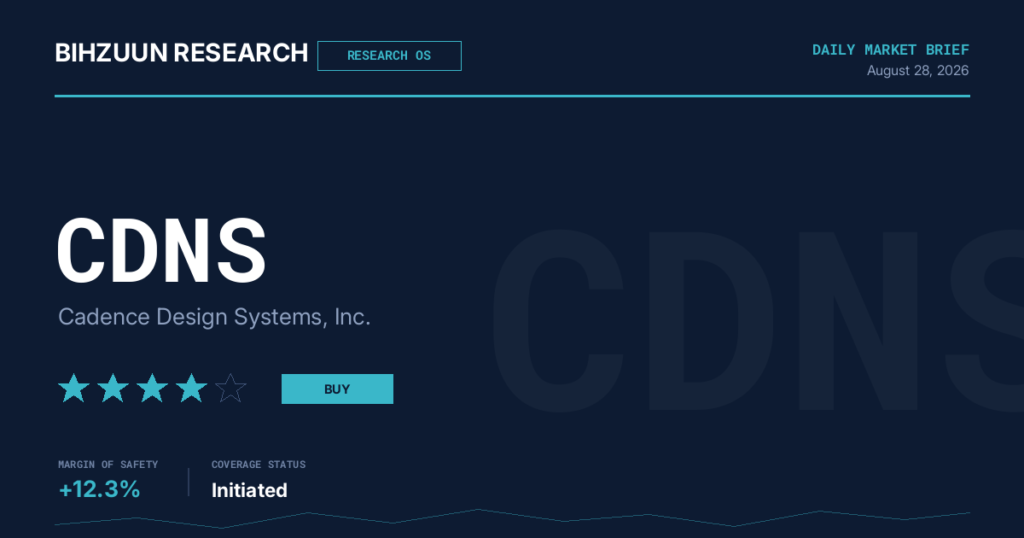
Cadence Design Systems (CDNS) — Institutional Research Report
Bihzuun Research | Sector: Electronic Design Automation & Semiconductor IP
Summary Table
| Metric | Value |
|---|---|
| Ticker | CDNS |
| BRS Rating | ★★★★★ Buy |
| Target Price (12-mo Base Case) | $340–$390 |
| Margin of Safety | 12.3% |
| Timeframe | 12 months |
| BRR Posture | Constructive Accumulation |
The Margin of Safety shown above is the Bihzuun Value Filter (BVF) screening figure that gated this company’s star rating. A separate multi-model composite figure is discussed — and explicitly labeled — in the Multi-Model Valuation Assessment section below.
1. Business Overview & Economic Moat
Cadence Design Systems sits at the structural core of the modern semiconductor value chain, supplying the electronic design automation (EDA) tools and semiconductor IP that underpin virtually every advanced chip design. The business is a capital-light software compounder: high recurring revenue, exceptional margins, and a moat that is not merely wide but deepening.
We assess Cadence’s moat as wide and durable, anchored on three interlocking pillars:
- Extreme switching costs — engineering teams spend years or decades mastering Cadence’s tool flows. Migrating a multi-billion-dollar chip design to a competitor’s platform is prohibitively expensive, slow, and error-prone. This is the single most powerful pillar of the franchise.
- Scale and network effects — Cadence reinvests over $1 billion annually in R&D to keep pace with Moore’s Law and escalating design complexity, a bar few competitors can clear.
- Portfolio breadth and AI-native positioning — first-mover advantage in agentic AI workflows, reinforced by the November 2025 ChipStack acquisition, ties the moat to customer complexity rather than price alone.
Recurring revenue at 78–80% of total (per Q2 2026 results) and a record $8.1B backlog give the moat a tangible financial signature — a theme that recurs directly in the Financial Deep Dive below.
2. Financial Deep Dive
On business quality, Cadence commands genuine respect. Our financial quality score of 81/100 reflects a franchise operating with software-economics purity.
- Revenue: $5,297M supporting net income of $1,109M — a net margin of ~20.9%, characteristic of the high-margin EDA/IP model.
- Return on Equity: 20.3% on a $5,474M equity base — efficient capital deployment, though amplified by leverage.
- Leverage: $2,480M long-term debt (31.2% ratio). Not alarming given durable recurring revenue, but it constrains balance-sheet flexibility and introduces interest-rate sensitivity — a point that connects directly to the multiple-compression risk flagged in Risk Mapping.
- EPS: $4.09, with a zero dividend payout. Management reinvests earnings entirely into growth, consistent with the compounder strategy; the growth sub-score of 100/100 validates the trajectory.
Momentum is unambiguous. Q2 2026 revenue reached $1.584B (+24% YoY), beating guidance, with net income of $367.1M (+129% YoY). All product groups grew double digits; IP grew over 40%. Full-year 2026 guidance was raised to $6.26–6.34B (18–20% growth) at a non-GAAP operating margin of 43.75–44.75%.
The financial critique is not about quality — it is about the price paid for it. The scorecard composite of 54.7/100 is dragged down by a 0/100 valuation sub-score and a 15/100 income score (reflecting the absent dividend). The investment case therefore rests almost entirely on growth continuation and tolerance for multiple expansion.
3. Multi-Model Valuation Assessment
Cadence’s valuation demands transparency because two distinct margin-of-safety figures diverge sharply, and conflating them would mislead.
The BVF screening margin of safety of 12.3% is the figure that gated the 4-star Buy rating. It incorporates growth-adjusted, forward-looking assumptions suited to Cadence’s business model and indicates modest but positive upside relative to assessed intrinsic value.
The 5-Model Composite Margin of Safety of -83.8% tells a very different story: a composite fair value of $56.21 against a current price of $347.55, implying the stock trades at roughly six times the composite’s central estimate.
Reconciling the divergence: the composite is built on thin, arguably unsuitable foundations for a high-growth software business, and the gap reflects methodological mismatch as much as overvaluation. Specifically:
- The DCF Declining model was excluded as a statistical outlier at $383.56 — notably the only model that approximates current market pricing.
- DDM and EPV are inapplicable (no dividend; the 11.3% growth rate violates EPV’s zero-growth premise).
- That leaves only a Graham Number of $43.11 and a Comparable analysis of $69.31 — two backward-looking, asset-heavy-oriented models that disagree with each other by 61%. A $56.21 median derived from these should carry low confidence.
The residual model-disagreement warning is well-placed: Cadence is genuinely difficult to value with traditional frameworks designed for slower-growing, asset-heavier businesses. The BVF figure of 12.3% diverges from the composite precisely because it better captures the growth trajectory the Graham/Comparable outputs ignore. Neither figure should be dismissed — but a reader must not read the -83.8% composite as a simple “overvaluation” verdict.
12-month base case: $340–$390, confidence rated low-to-moderate given valuation-model unreliability.
4. Competitive & Industry Analysis
EDA is a hardening duopoly. Synopsys and Cadence together control roughly 85% of the global market. Synopsys holds a narrow lead at ~38%; Cadence is extremely close at ~36% — the only franchise of comparable scale to its rival. Cadence continues to take share in hardware emulation, IP, and System Design & Analysis while maintaining strong analog and digital positions.
The most meaningful 2025 development was structural: Synopsys closed its ~$35B Ansys acquisition (July 2025), expanding its multiphysics and system-level simulation footprint. Cadence’s response has been the ~$3.16B Hexagon deal and a pronounced push into agentic AI, including the AuraStack AI Super Agent (extending AI agents across PCB and advanced packaging) and InnoStack’s role in the Rapidus collaboration.
Two upside levers stand out:
- AI-native design flow adoption across chips and full systems — the primary structural catalyst, reinforcing the switching-cost moat if customers realize tangible productivity gains versus open-source and in-house alternatives.
- Intel Foundry opening — Cadence is targeting traction at Intel (historically a weak position relative to TSMC/Samsung strength), with restructuring and leadership turnover creating the largest evaluation window in a decade.
Deep partnerships with NVIDIA, Intel, TSMC, Samsung, Google, and Rapidus underpin the AI-acceleration narrative that investors lean on to justify the premium multiple — the same premium that dominates the risk discussion below.
5. Risk Mapping
- Valuation risk (most immediate): trailing P/E of 84.89; forward P/E of 44.68; ~64.9x on a blended basis versus a software-industry average near 31.4x, a peer average near 44.0x, and a tailored fair P/E closer to 34.5x. The market already grants full credit for the upcoming growth cycle, so any execution hiccup invites sharp de-rating. Insiders have sold a combined $34.2M in shares — a signal worth monitoring. This directly amplifies the interest-rate sensitivity noted in the Financial Deep Dive.
- Geopolitical & regulatory risk: China was 13% of FY2025 revenue; management applies “prudence” in guidance. The 2026 policy environment is a managed bifurcation, and the China regulatory premium is now permanent, not cyclical. A March 2026 CSIS survey found more than half of surveyed firms faced license review times averaging over 180 days.
- Disruption risk: open-source EDA and in-house tooling are longer-tailed but real threats; intensifying AI-tool competition could erode pricing power over time.
- Cyclicality: Cadence’s fortunes are tied to semiconductor capex cycles — a downturn could slow bookings and revenue despite the recurring-revenue cushion.
6. Catalyst Monitor
- Broadcom Q3 FY2026 earnings (CRITICAL, Sep 2–3): AI semiconductor guidance projecting ~$16B in AI revenue (+200% YoY) sets the tone for the entire AI-driven EDA demand thesis. A strong print validates CDNS end-market assumptions; a miss could reprice the cohort lower.
- Macro sequence: Sep 4 nonfarm payrolls, CRITICAL Sep 11 CPI, and the Sep 16 FOMC (first dot-plot update since June) will determine whether the yield curve steepens (bearish for high-multiple growth) or flattens on a dovish pivot (constructive).
- Q3 2026 earnings (late October, primary idiosyncratic catalyst): guidance of non-GAAP EPS $2.01–$2.07 on revenue $1.595–1.625B — a bar that appears achievable given backlog composition.
7. Investment Verdict
★★★★★ Buy
BRR Posture: Constructive Accumulation (Neutral-Regime Conviction)
Cadence is among the highest-quality EDA franchises in the world — a wide, deepening moat, a record $8.1B backlog, ~80% recurring revenue, and genuine AI monetization tailwinds. It also exemplifies the defining tension of a neutral market regime: exceptional business quality priced at a multiple that leaves near-zero room for execution error.
Prior Bihzuun coverage has screened CDNS twice since 2026-08-04, passing both consecutive screens, with the BVF margin of safety drifting modestly from 12.4% to 12.3% (a declining trend, but still positive). The 4-star Buy rating is gated by that BVF figure; the -83.8% 5-Model Composite Margin of Safety reflects methodological mismatch between traditional models and a high-growth software franchise, not a clean overvaluation signal.
The August 2016 Jackson Hole analog (high similarity) frames current price action — a strong rally consolidating ahead of policy clarity. The 2022 analog warns that a hawkish CPI surprise plus a higher-for-longer FOMC dot plot would expose the premium multiple to asymmetric compression. Accordingly, aggressive initiation into the next macro-binary window is a risk the neutral regime does not reward.
The disciplined posture is constructive accumulation into macro-driven weakness, with the $320–$330 zone identified as a preferred entry band, post-FOMC clarity, rather than momentum-chasing at elevated levels. The late-October Q3 print remains the cleanest idiosyncratic catalyst; the Broadcom print and September FOMC are the macro gatekeepers framing the setup.
Disclaimer
This report is produced by Bihzuun Research for informational and educational purposes only and does not constitute investment advice, a recommendation, or an offer or solicitation to buy or sell any security. The Bihzuun Research Score (BRS) and Bihzuun Research Rating (BRR) reflect proprietary methodology and internal assumptions that may prove incorrect. Valuation figures — including both the Bihzuun Value Filter (BVF) screening margin of safety and the 5-Model Composite Margin of Safety — are estimates subject to significant model uncertainty, particularly for high-growth franchises poorly suited to traditional valuation frameworks. Past performance and historical analogs are not indicative of future results. Investors should conduct their own due diligence and consult a qualified financial advisor before making any investment decision.