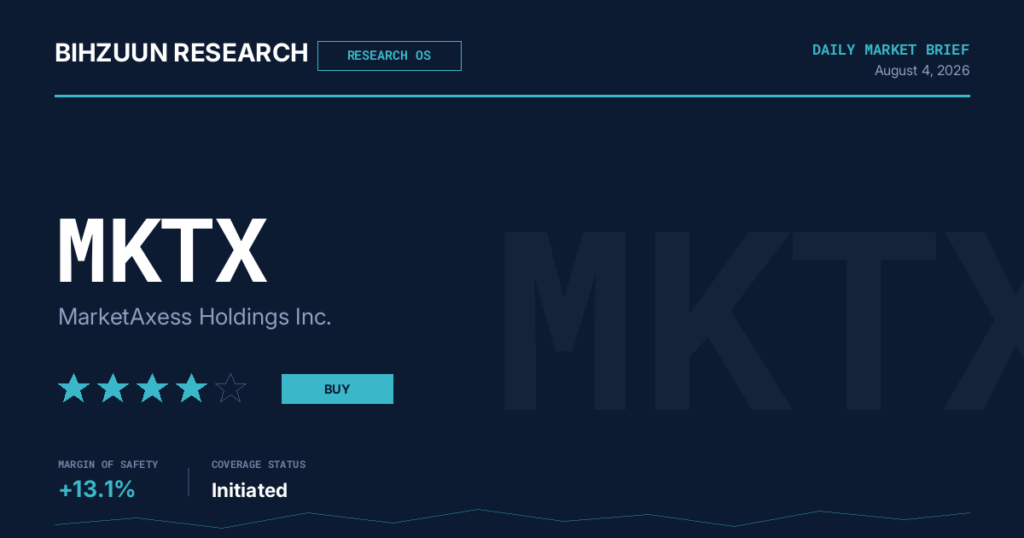
MarketAxess Holdings, Inc. (MKTX) — Institutional Research Report
A Bihzuun Research institutional assessment integrating financial quality, multi-model valuation, competitive positioning, and event-driven catalyst analysis. This report treats MKTX as a transformed security: a high-quality operating franchise that, as of the ICE acquisition announcement, has become predominantly a merger-arbitrage instrument.
1. Summary Table
| Metric | Assessment |
|---|---|
| Ticker | MKTX (MarketAxess Holdings, Inc.) |
| Bihzuun Research Score (BRS) | ★★★★★ Buy |
| Target Price | $175–$190 (18–24 month standalone base case); ~$167 deal-anchored near-term |
| Margin of Safety | 13.1% (declining from 17% prior screen) |
| Timeframe | 18–24 months (fundamental) / H1 2027 (deal close horizon) |
| Screening History | Screened 2× since 2026-07-08; passed last 2 consecutive screens |
Note on Margin of Safety: The 13.1% figure shown above is the Bihzuun Value Filter (BVF) screening margin of safety — the figure that directly gated the current 4-star rating. A separate multi-model composite margin-of-safety figure, which diverges sharply, is discussed and explicitly labeled in Section 4. Readers should not conflate the two.
2. Business Overview & Economic Moat
MarketAxess operates a leading electronic trading platform delivering trading efficiency, diversified liquidity pools, and material cost savings to institutional investors and broker-dealers across global fixed-income markets. The franchise serves approximately 2,100 institutional and broker-dealer clients, combining diverse trading protocols, automated and algorithmic execution, intelligent data products, and comprehensive post-trade and technology services.
The core moat is a network flywheel: more liquidity providers attract more order flow, which in turn deepens liquidity. Its Open Trading all-to-all model and proprietary data assets remain genuine structural advantages that are difficult for entrants to replicate quickly.
Moat trajectory — narrowing but structurally real. MarketAxess once held a near-monopoly in electronic trading of U.S. credit. Competition, primarily from Tradeweb and more recently Trumid, has eroded that dominance to roughly a 38% share of electronic volumes in 2025. Voice trading still dominates U.S. credit, implying meaningful structural runway for electronic penetration — though recent stagnation in penetration trends has been disappointing. Tellingly, ICE CEO Jeffrey Sprecher publicly acknowledged that MarketAxess faces “tough competition” from rivals operating within “a larger ecosystem with a broader pool of products.” Coming from the acquirer, that is both a deal rationale and a candid assessment of MKTX’s standalone vulnerability — a theme that reverberates through the valuation dispersion (Section 4) and the competitive analysis (Section 5).
3. Financial Deep Dive
On operational quality, MKTX presents an impressive profile that underpins the favorable BRS rating:
- Revenue: $849M
- Net Income: $247M (~29% net margin — exceptional for a fintech/trading platform)
- Return on Equity: 21.5%, generated with zero long-term debt — a genuinely unlevered return reflecting operational efficiency rather than financial engineering
- Balance Sheet Score: 100/100 — the absence of debt removes an entire category of financial risk
- Dividend Yield: 1.90% on a 46.2% payout ratio — disciplined capital return retaining over half of earnings for reinvestment
- Scorecard: Growth 92, Financial Quality 86
The counterweight is the valuation component scoring 0/100 — a material red flag that no amount of operational strength should obscure. This tension between exceptional business quality and demanding valuation is the central analytical fault line of the MKTX thesis.
Recent operating data, however, confirm competitive erosion: Q2 2026 revenue of $218.4M was roughly flat year-over-year, total commission revenue declined 3% to $186.9M, and total expenses rose 1% to $128.5M. Pockets of strength persist — block trading ADV rose 11% to $5.9B and portfolio trading ADV rose 33% to a record $2.0B — but were insufficient to reverse share losses.
4. Multi-Model Valuation Assessment
Valuation is where the MKTX picture becomes genuinely difficult, and the two distinct margin-of-safety measures must be kept separate.
BVF Screening Margin of Safety: +13.1% — This is the figure that gated the 4-star Buy rating and the figure shown in the Summary Table. It reflects a narrow but positive buffer.
5-Model Composite Margin of Safety: −44.9% — A separate cross-check. Against the current price of $162.28, the composite median intrinsic value is $89.37, implying meaningful overvaluation on that basis. This figure belongs solely to this section and must never be presented under the unqualified “Margin of Safety” label.
Reconciling the divergence: These two measures disagree sharply, and the discrepancy must not be glossed over. The composite median is dragged down heavily by models poorly suited to a capital-light platform business. Individual model outputs:
| Model | Output | Note |
|---|---|---|
| DCF (declining growth) | $183.46 | Most weight for asset-light franchise |
| Comparable | $89.37 | Composite median anchor |
| Graham Number | $68.09 | Designed for asset-heavy industrials; likely undersells this business |
| Gordon Growth DDM | $318.30 | Excluded — statistical outlier |
| EPV | Inapplicable | 8.9% growth exceeds zero-growth assumption |
Even after excluding the DDM outlier, the three remaining models still disagree by 169% — the highest ($183.46) is nearly triple the lowest ($68.09). The composite median of $89.37 should therefore be read not as a precise estimate but as the midpoint of a very wide uncertainty band. The Graham Number in particular almost certainly understates a capital-light, high-ROE platform. Weighting the DCF most heavily, a reasonable standalone base case target of $175–$190 over 18–24 months is defensible, though confidence is moderate at best given the dispersion. The BVF’s 13.1% provides a narrow buffer, not a classical wide margin of safety.
Critical overlay: As detailed in Sections 5–7, the standalone valuation debate is now largely subordinated to the ICE cash deal at $167/share, which effectively caps upside and reframes price discovery around deal completion rather than intrinsic value.
5. Competitive & Industry Analysis
The competitive map has shifted materially against MarketAxess over two years. In June 2026 — the month before the ICE deal — MarketAxess fell behind Tradeweb in U.S. credit electronic trading market share for the first time, crystallizing the competitive pressure that had been building.
Tradeweb is executing at scale: second-highest quarterly revenue ever at $559M, growth accelerating past 20% year-over-year in June, record core swaps market share of 24.1%, and institutional U.S. Treasury share above 50% for a ninth consecutive quarter. Tradeweb CEO Billy Hult called the ICE–MKTX deal “a validation of the credit fee pool,” signaling confidence that the strongest platforms will win on technology and transparency. Bloomberg’s terminal ubiquity and expanding credit presence further fragment liquidity formation across venues.
This competitive deterioration is the connective tissue of the entire thesis: it explains the moat narrowing (Section 2), the flat Q2 revenue (Section 3), the demanding-yet-uncertain valuation (Section 4), and ultimately the strategic logic of ICE’s acquisition (Section 6).
6. Risk Mapping
⚠ MKTX is now a merger-arbitrage situation, not a standalone fundamental equity story. ICE will acquire all outstanding MKTX shares for $167 per share in cash — a 33% premium to the July 29, 2026 close — for equity value of ~$6.0B and enterprise value of ~$5.7B. ICE targets $100M in annualized synergies within three years of close and plans debt financing yielding pro forma gross leverage of ~3.4x (targeting ≤3.0x within 18–24 months) — giving ICE strong economic incentive to close efficiently.
- Antitrust failure (dominant risk): The combined position in electronic fixed-income trading and data could trigger rigorous review. Failure would likely send MKTX back toward the mid-$120s — roughly 20–25% downside from $167. ICE would owe a $327.4M termination fee if antitrust conditions block closing after other conditions are met.
- Litigation overhang: Multiple firms are investigating whether directors secured a fair price and met fiduciary duties, potentially complicating the stockholder vote or proxy timeline.
- Deal timeline: Close expected H1 2027, subject to stockholder approval, HSR expiration, other regulatory approvals, and absence of a Material Adverse Effect.
- Standalone/fundamental risk: Competitive share loss, volume compression in low-volatility regimes, and the valuation scorecard’s 0/100 reading all reassert themselves if the deal fails.
- Macro/rate sensitivity: As rate-sensitive financial infrastructure, standalone intrinsic value is tied to spread volatility. Key data — July payrolls (Aug 7, prior +57K), July CPI (Aug 12), and Jackson Hole (Aug 27–29, Chair Warsh) — would matter most if the deal were to fail.
- Upside optionality: A competing bid, while structurally discouraged by the $148.8M termination fee MKTX would owe ICE, cannot be entirely ruled out given the asset’s strategic value.
Risk/reward is asymmetric to the downside: deal success captures only the residual spread to $167 plus the $0.78/share dividend (payable Sept 2); deal failure carries 20–25% downside.
7. Catalyst Monitor
- Aug 7, 2026: July payrolls print + shareholder-litigation developments — first binary input.
- Aug 12, 2026: July CPI — rate-volatility signal relevant to any standalone re-rating scenario.
- Aug 27–29, 2026: Jackson Hole (Chair Warsh) — macro wildcard for the rate-sensitive infrastructure complex.
- Sept 2, 2026: $0.78/share dividend payable — component of arb carry.
- Ongoing: HSR waiting period, proxy solicitation and stockholder vote, antitrust review progression.
- H1 2027: Targeted deal close.
Note: MKTX canceled its August 7 earnings call, withdrew 2026 guidance and medium-term targets, and suspended monthly volume releases — effectively shutting off fundamental-driven price discovery. The stock now trades as a cash merger anchored at $167.
8. Investment Verdict — BRS Rating & BRR Posture
★★★★★ Buy
Bihzuun Research Rating (BRR) Posture: Constructive / Event-Driven Hold. The 4-star BRS Buy is anchored by MarketAxess’s exceptional operating quality — 29% net margins, 21.5% debt-free ROE, a pristine balance sheet — and a positive BVF screening margin of safety of 13.1%. However, investors must internalize that the security has been fundamentally transformed by the ICE cash acquisition at $167/share. It is no longer a standalone equity thesis but a merger-arbitrage position with a binary payoff structure.
The valuation cross-check reinforces caution: while the DCF-weighted standalone base case supports $175–$190, the 5-Model Composite Margin of Safety of −44.9% (median $89.37) signals that, absent the deal, the shares would screen richly. This divergence is reconciled by the poor fit of asset-heavy valuation models to a capital-light platform and by wide model dispersion — but it is precisely why the deal represented a rational strategic outcome rather than an opportunistic premium.
Bottom line: Holding MKTX near current levels is a carry trade in the deal spread, appropriate for investors with conviction in antitrust clearance. The upside is the residual spread to $167 plus the dividend; the downside is a 20–25% retracement toward the mid-$120s on deal failure. Investors lacking specific regulatory conviction should size the position accordingly and monitor the August 7 litigation and August 12 CPI inputs as the next meaningful binary signals.
Disclaimer
This report is produced by Bihzuun Research for informational and educational purposes only and does not constitute investment advice, a recommendation, or a solicitation to buy or sell any security. The Bihzuun Research Score (BRS) and Bihzuun Research Rating (BRR) reflect proprietary analytical frameworks and are subject to change without notice. Valuation figures, including the Bihzuun Value Filter (BVF) screening margin of safety and the separately labeled 5-Model Composite Margin of Safety, are estimates derived from models with inherent uncertainty and may differ materially from realized outcomes. Merger-related situations carry binary regulatory and timeline risks. Investors should conduct their own due diligence and consult a qualified financial advisor before making any investment decision. Past performance and prior screening results are not indicative of future results.