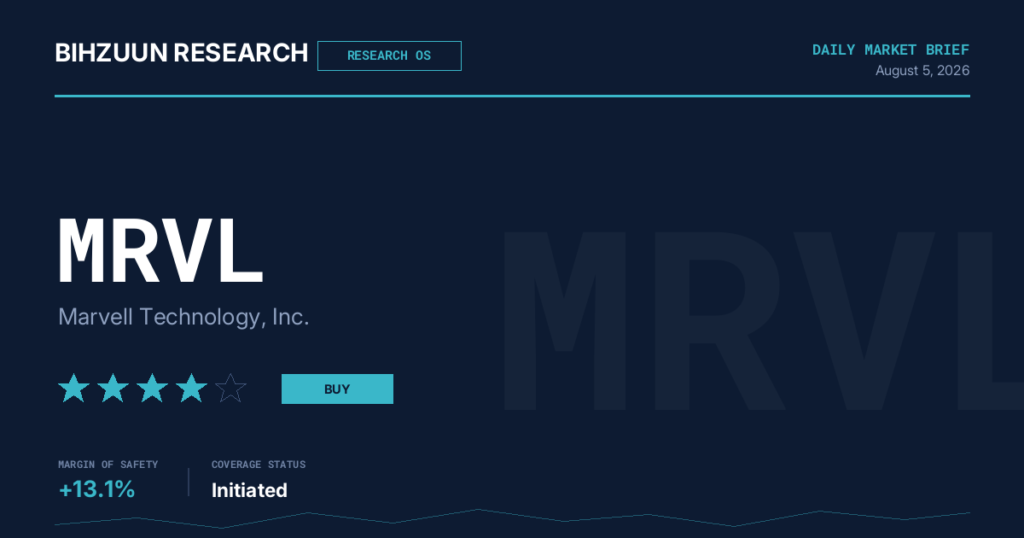
Marvell Technology (MRVL) — Institutional Research Report
Bihzuun Research | Prepared by the Office of the Research Director | August 5, 2026
1. Summary Table
| Metric | Assessment |
|---|---|
| Ticker | MRVL (Marvell Technology) |
| Bihzuun Research Score (BRS) | ★★★★★ Buy |
| Target Price Range | $45–$56 (fundamental floor) vs. $218.59 current market price |
| Margin of Safety | 13.1% |
| Timeframe | Medium-term (12–24 months) |
The “Margin of Safety” figure above (13.1%) is the Bihzuun Value Filter screening margin that gated this company’s star rating. A separate composite valuation figure is discussed and explicitly labeled in Section 4.
2. Business Overview & Economic Moat
Marvell Technology has completed a structural transformation from a broad-based analog and mixed-signal semiconductor supplier into a core enabler of the AI infrastructure build-out. Custom ASIC programs are ramping rapidly for major hyperscalers, and optical interconnect solutions are capturing share in next-generation AI clusters.
The moat is genuine, multi-layered, and defensible on a medium-term horizon. Marvell is the only player simultaneously covering custom ASIC design, 1.6T optical DSP, silicon photonics (via the Celestial AI acquisition), and CXL switching — a full-stack positioning no single competitor replicates today. Deep, multi-year strategic relationships with the world’s largest hyperscalers — built on proven custom ASIC execution, best-in-class SerDes, and PAM4 DSP technology — create formidable barriers: new entrants face years of qualification cycles before displacing an embedded design win. Those hard-to-displace design wins are the core of the moat.
- Interconnect revenues: expected to grow more than 70% year over year in fiscal 2027.
- Scale-out switch revenues: expected to exceed $600 million in FY2027, reaching a $1 billion+ annualized run rate in FY2028.
- Custom revenues: on track for 20%+ growth in FY2027, more than doubling in FY2028.
- Long-dated guidance: FY28 revenue targeted at $16.5B; custom silicon expected to surpass $10B by FY29; data center growth ~50% this year.
Recent M&A deepens the moat: Celestial AI closed February 2, 2026, and XConn Technologies February 10, 2026, securing silicon photonics and CXL capabilities — funded in part by a $2 billion Series A Convertible Preferred raise on March 31, 2026, which adds balance sheet complexity (a point that resurfaces in Section 3). An expanded NVIDIA partnership links Marvell’s custom silicon and optical networking to NVLink Fusion, optics, and AI-RAN opportunities, while newly previewed AI memory and storage expansion solutions for Agentic AI and large-model inference widen addressable revenue per server.
3. Financial Deep Dive
Marvell presents a genuinely bifurcated picture: strong underlying business fundamentals sit in sharp tension with a valuation that is difficult to anchor with confidence. The financial quality side is largely constructive.
- Revenue: $8.195 billion.
- Net income: $2.670 billion — a net margin approaching 33%, exceptional for a semiconductor company of this scale and a signal of meaningful pricing power and operating leverage.
- Return on equity: 18.7% — healthy, though the $14.308 billion equity base reflects significant acquisition-driven goodwill and intangible accumulation investors should note (a direct consequence of the acquisition spree cited in Section 2).
- Long-term debt: $3.971 billion; LT debt ratio 21.7% — manageable at current earnings levels, not an immediate serviceability concern.
- Dividend yield / payout ratio: 0.11% / 7.7% — virtually all earnings retained, consistent with a growth-reinvestment posture rather than an income thesis.
- EPS: $3.10.
Internal scorecard readings: financial quality 75, balance sheet strength 73 — both respectable. Growth earns a perfect 100, reflecting the momentum that has driven Marvell’s narrative and its current market price. That very momentum, however, is precisely what makes valuation so difficult, as Section 4 details.
4. Multi-Model Valuation Assessment
The valuation picture is deeply uncertain and must be stated plainly. Two distinct margin-of-safety figures arise from two different methodologies, and they tell very different stories.
- Bihzuun Value Filter (BVF) screening margin of safety: 13.1% — a modest positive figure and the number that actually gated the 4-star Buy designation (see Summary Table).
- 5-Model Composite Margin of Safety: -79.5% — derived from a composite intrinsic value of $44.81 against the current price of $218.59.
These two figures diverge by roughly 93 percentage points, and that discrepancy demands explicit acknowledgment rather than selective citation. The BVF screen and the multi-model composite measure different things using different methodologies. The BVF figure is the screening margin that gated the rating; the composite figure is a static intrinsic-value anchor that does not capture the AI-driven demand premium embedded in the market price. The reader should never conflate the two.
Within the composite itself, confidence is limited. Of five models, four are excluded or inapplicable:
- DCF Declining ($247.14): excluded as a statistical outlier relative to peer models.
- DDM Gordon Growth: unstable — growth rate exceeds discount rate.
- EPV: inapplicable — a 12.0% growth assumption violates its zero-growth premise.
- Graham Number ($34.04) and Comparable ($55.57): the two surviving models — which themselves disagree by 63%.
A median composite of $44.81 built from only two widely divergent models should be treated as an approximate anchor, not a precise estimate. The residual disagreement confirms that Marvell is genuinely hard to value with conventional frameworks — primarily because its growth rate is so high that it breaks the assumptions underlying several standard models.
Target range: The most intellectually honest target is a wide band. The $45–$56 composite range represents the book-value-and-earnings-anchored floor should growth-adjusted DCF assumptions normalize and the market re-rate toward fundamentals. The current $218.59 price essentially prices in a sustained premium for AI-driven semiconductor demand that the static models cannot capture. Confidence in any near-term price target is low.
5. Competitive & Industry Analysis
The primary rival is Broadcom (AVGO), and the two exist in a functional duopoly for high-end custom ASICs and networking silicon. The scale divergence is stark: Broadcom reported Q2 FY2026 revenue of $22.187 billion (+47.9% YoY) versus Marvell’s $2.418 billion in Q1 FY2027 — same theme, vastly different scale. Broadcom is the clear market leader in custom AI accelerators, commanding more than 70% share in that category.
The dynamic is nuanced. Broadcom holds edges in scale, a broader software portfolio (VMware), and a deeper Google TPU partnership; Marvell is viewed as the more flexible partner for hyperscalers like Amazon AWS and Microsoft, having won significant slots on Amazon’s Trainium 2 and Microsoft’s Maia AI chips. That flexibility is a strength — but Amazon Web Services as the largest customer creates elevated concentration risk (see Section 6). AMD and Intel are secondary threats in adjacent categories; neither currently challenges Marvell’s optical DSP near-monopoly.
Valuation asymmetry is a live risk: AVGO trades at a forward P/E of ~32 while MRVL sits at ~66 after an earlier 250% year-to-date rally — steep for the smaller player. The Street is broadly constructive: 50 analysts cover MRVL with an average target of $248.04 (~37% implied upside) and an 82% buy consensus. Note, however, that a crowded bull consensus in high-beta AI names is precisely the environment where consensus breaks down fastest — a caution that connects directly to the valuation fragility in Section 4 and the risk map below.
6. Risk Mapping
The risk profile is asymmetric: upside is structurally sound and well-documented, but downside risks are concentrated, interconnected, and capable of moving fast.
- Macro & rate risk (most immediate): Marvell sells into long-cycle hardware demand but trades like a growth equity valued on future earnings. Rising Treasury yields mechanically compress the P/E multiple. With a beta of 2.2, MRVL is the most rate-sensitive major chip name in the AI complex. The current yield-curve steepening in a reflationary regime is a structural headwind to its premium valuation — the same premium the static models in Section 4 cannot support.
- Foundry & supply chain risk (underappreciated): Heavy reliance on TSMC’s 3nm and 5nm nodes. TSMC raised FY capex guidance to $60–$64B (from a $56B ceiling) and warned that overseas expansion and 2nm ramp costs would dilute gross margins in H2 — costs that flow upstream to fabless customers as pricing pressure. Escalating U.S.–China trade tensions and Middle East instability (including lagged Strait of Hormuz effects on energy and rare earth transport) add slow-moving margin headwinds.
- Customer concentration risk (most company-specific): Beta of 2.2 plus heavy concentration means any AI capex slowdown, shift to in-house chips, or project delay at key hyperscalers could rapidly reverse gains and invalidate analyst targets. Gradual in-sourcing of silicon design capability is a multi-year structural threat the market may be under-pricing.
- Valuation risk (compounds all above): Trailing P/E ~56x, forward P/E ~43x, price-to-sales ~17 leave virtually no cushion against a miss, guidance cut, or sector derating. Hyperscaler capex revision fears alone triggered a two-day chip selloff that cut 31% from the stock in one month despite a 125% YTD run. The partial recovery to the ~$183 area, following a drawdown from a 52-week high near $316, reflects fear normalization — not a structural all-clear.
7. Catalyst Monitor
Critical flag — August 27, 2026 earnings. Marvell reports Q2 FY2027 with revenue guided at ~$2.7B (above the ~$2.6B Street average), consensus EPS of $0.94 and consensus revenue of $2.76B. The market has priced a ±18% move. The tells are not the headline numbers — likely achievable given Q1 bookings commentary — but the quality of custom XPU ramp color, gross margin trajectory against acquisition integration costs, and FY28 guidance credibility. Watch whether 1.6T optics and custom XPU ramps translate booked demand into gross margin expansion alongside top-line growth.
Compound volatility scenario. The same day, Fed Chair Kevin Warsh is expected to speak at Jackson Hole. Strong earnings paired with a hawkish surprise could whipsaw in both directions; a dovish signal plus a beat-and-raise could catalyze a sharp re-rating. The risk is multi-dimensional, not merely binary. Investors long into August 27 should size accordingly.
Pre-earnings macro calendar:
- Aug 7: July Employment Situation (following June’s weak +57K print) — potential Treasury yield volatility that hits MRVL before any earnings line is written.
- Aug 12: July CPI.
- Aug 13: AMAT earnings — a direct read-through on AI semiconductor equipment demand and export-control risk.
Bank of America now expects hyperscaler capex above $1.2 trillion over the next 12 months; Morgan Stanley projects $800 billion in 2026 and $1.2 trillion in 2027. These represent a secular tailwind — but are also the exact figures that would compress sharply in a hard-landing scenario triggered by a weak payroll print, tying the catalyst calendar directly to the concentration and macro risks in Section 6.
8. Investment Verdict — BRS Rating & BRR Posture
★★★★★ Buy
Bihzuun Research Rating (BRR) Posture: Constructive, Volatility-Aware. Marvell earns a 4-star Buy on the strength of a genuine, full-stack AI infrastructure moat, exceptional ~33% net margins, healthy 18.7% ROE, a perfect growth score, and a BVF screening margin of safety of 13.1% that gated the rating. The investment case rests on structurally sound, well-documented upside as custom silicon, interconnect, and optical franchises scale toward management’s FY28–FY29 targets.
That constructive posture is deliberately tempered. As Section 4 makes explicit, the 5-Model Composite Margin of Safety is deeply negative (-79.5%) because conventional static models cannot capture Marvell’s AI-driven growth premium — four of five models were excluded or inapplicable, and the surviving pair disagree by 63%. Confidence in a near-term price target is low, and the wide $45–$56 fundamental floor should be read as an anchor, not a precise estimate. Layered on top are elevated rate sensitivity (beta 2.2), foundry dependence on TSMC, hyperscaler concentration led by AWS, and a compound-volatility earnings event on August 27. Investors should treat this as a high-conviction franchise held at a high-risk valuation, and size positions accordingly.
Bihzuun Research Disclaimer: This report is produced by Bihzuun Research for institutional informational purposes only and does not constitute investment advice, a recommendation, or an offer or solicitation to buy or sell any security. Bihzuun Research Scores (BRS) and Bihzuun Research Ratings (BRR) reflect proprietary methodology and are subject to change without notice. Valuation figures, including screening and composite margin-of-safety estimates, are model-derived, carry inherent uncertainty, and should not be relied upon as precise forecasts. Past performance is not indicative of future results. Investors should conduct their own due diligence and consult qualified advisors before making any investment decision.