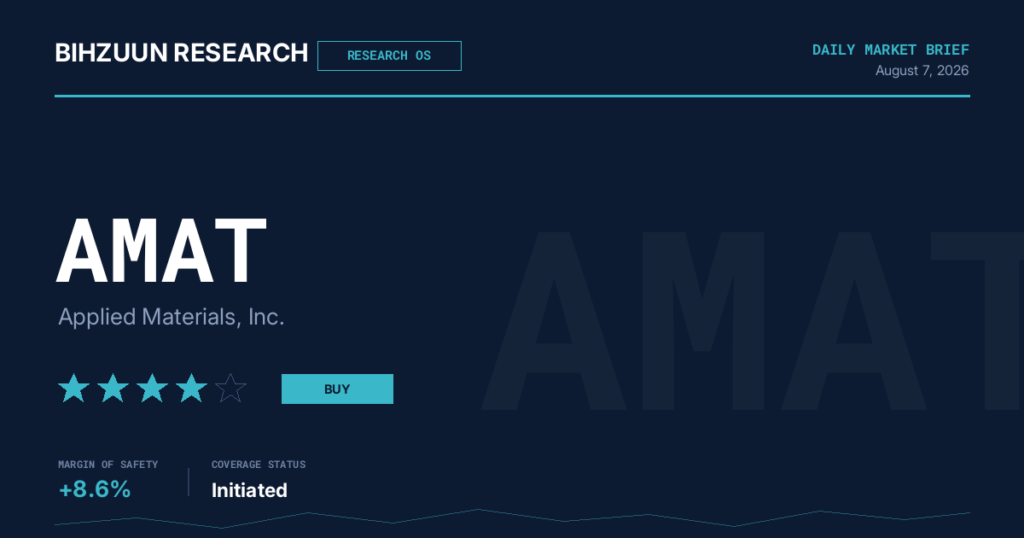
Applied Materials, Inc. (AMAT) — Bihzuun Research Report
1. Summary Table
| Metric | Assessment |
|---|---|
| Ticker | AMAT (NASDAQ) |
| Bihzuun Research Score (BRS) | ★★★★★ Buy |
| Target Price (12-Month Base Case) | $550 – $575 |
| Margin of Safety | 8.6% |
| Timeframe | 12 Months |
| Bihzuun Research Rating (BRR) Posture | Constructive — Accumulate on Macro-Driven Weakness |
Coverage continuity: AMAT has now cleared the Bihzuun Value Filter (BVF) on three consecutive screens since July 24, 2026, with the screening margin of safety improving marginally across the sequence (8.5% → 8.5% → 8.6%). The trend is stable-to-improving, reinforcing the durability of the current 4-star posture.
2. Business Overview & Economic Moat
Applied Materials is the world’s largest supplier of wafer fabrication equipment, commanding approximately 19% of the global semiconductor equipment market. The defining feature of its franchise is breadth: AMAT holds leadership across deposition (~30% share), etch, and metrology/inspection, allowing it to bundle solutions across the fab floor in a way no single peer can replicate. Where Lam Research competes on etch depth and KLA on yield-management dominance, AMAT competes across the entire process chain — a structurally differentiated moat.
Moat durability is anchored to the industry’s technology roadmap. AMAT’s portfolio breadth positions it to benefit disproportionately from the transitions now underway — 2nm gate-all-around (GAA) transistors, 3D NAND scaling, and the accelerating shift toward advanced packaging. Management projects more than 30% growth in its semiconductor equipment business and over 50% growth in packaging revenue for 2026, while the services segment — a recurring-revenue underpinning expected to compound at a mid-teens rate — cements switching costs as installed-base utilization rises.
Capital allocation reinforces the moat: the $500M Tampines Campus in Singapore more than doubles local cleanroom capacity, the $5B EPIC Center in Silicon Valley deepens R&D leadership, and a 15% dividend increase marks nine consecutive years of growth. As detailed in Section 3, this is deployed from a position of financial strength rather than balance-sheet stress.
3. Financial Deep Dive
AMAT’s operating quality is difficult to fault and forms the backbone of its 4-star rating notwithstanding valuation contention.
- Revenue: $28.37 billion
- Net Income: $6.998 billion (net margin ~24.7% — exceptional for a capital equipment manufacturer)
- Return on Equity: 34.3% on a $20.42 billion equity base
- EPS: $8.71
- Long-Term Debt: $6.455 billion (LT debt ratio 24.0%) — comfortably serviceable, with annual net income covering the entire debt load within roughly twelve months
- Dividend Yield / Payout: 0.36% / 21.9% — a deliberately conservative return policy preserving flexibility for buybacks, R&D, and M&A
The Bihzuun internal scorecard reflects this bifurcation cleanly: Financial Quality scores a perfect 100, Growth 100, and Balance Sheet 70. The drag is concentrated entirely in Valuation (0) and Income (9), pulling the composite to 60.4 of 100. In plain terms: the business is elite; the price at which the market offers it is the debate — a tension carried directly into Section 4.
4. Multi-Model Valuation Assessment
Intellectual honesty requires presenting two distinct margin-of-safety figures and reconciling why they diverge so sharply.
BVF Screening Margin of Safety: 8.6%. This is the figure that gated AMAT’s 4-star Buy rating and appears in the Summary Table above. It reflects a growth-adjusted, earnings-power framework consistent with AMAT’s actual business model, and it registers the stock as marginally undervalued.
5-Model Composite Margin of Safety: –80.8%. The separate composite framework produces a fair value of $101.35 against a current price of $527.48. This figure belongs only to the composite exercise below and should never be conflated with the BVF screening figure above.
The two figures diverge by roughly 89 points. The divergence is explained principally by the fragility of the composite:
- DCF Declining: $572.83 — excluded as a statistical outlier relative to peer models (though notably consistent with the constructive base case).
- DDM Gordon Growth: unstable — growth exceeded the discount rate.
- Earnings Power Value: inapplicable — a 10.1% growth rate violates its zero-growth assumption.
- Graham Number: $70.57 — structurally ill-suited to a high-multiple, high-growth equipment franchise.
- Comparable Model: $132.13 — more contextually grounded, but still prices AMAT at roughly a quarter of market value.
The composite median of $101.35 rests on only two usable outputs separated by an 87% spread — a level of residual model disagreement that makes confident reliance on the composite misleading. The Graham Number in particular penalizes precisely the growth and intangible-driven characteristics that define AMAT’s moat (Section 2).
Reconciliation: By traditional static valuation tools, AMAT screens as deeply overvalued. By the growth-calibrated BVF framework, it screens as marginally undervalued. The truth likely lies between, with an exceptionally wide uncertainty band. Our base-case 12-month target of $550–$575 aligns with the excluded DCF sensitivity range ($540.30–$606.57) and with the sell-side average target of $635.41 (implied ~12.6% upside). Confidence is deliberately moderate (~40–45%) given the model fragmentation.
5. Competitive & Industry Analysis
The semiconductor equipment oligopoly is defined by four dominant players: ASML (the sole source of EUV lithography), Lam Research (etch and deposition), KLA (inspection and metrology), and Applied Materials (the broadest portfolio). The strategic axis is breadth versus depth — AMAT wins on floor-wide bundling, its peers on specialized dominance.
KLA remains the margin king (60.9% gross, 38.2% operating, 33.4% net), reflecting its capital-light, recurring inspection model — a useful benchmark against which AMAT’s still-excellent 24.7% net margin (Section 3) should be read as breadth-driven rather than deficient. Lam’s moat rests on specialized process technology and high switching costs.
The most important competitive risk is asymmetric and geopolitical: Chinese domestic challengers such as NAURA are advancing, while non-U.S. competitors (ASML, Tokyo Electron) face fewer restrictions and can still serve restricted Chinese fabs that AMAT cannot. This creates a structural disadvantage specific to U.S. names — a risk quantified in Section 6.
6. Risk Mapping
- China Exposure (Structural). AMAT guides to a potential $600M–$710M FY2026 revenue loss from restrictions. China has fallen from ~40% of revenue (2023) to ~25–30% today. Roughly $110M of Q4 FY2025 product went unshipped under an affiliate export rule now suspended, not removed — reinstatement is a permanent background threat and the single most policy-sensitive variable on the upcoming call. AMAT can no longer serve China’s memory or mature-node markets under tightened controls.
- Valuation / Multiple Compression. As Section 4 makes clear, valuation support is concentrated in growth assumptions. Any cyclical slowdown or sustained elevation in long rates could compress the multiple rapidly.
- Cyclicality. A semiconductor equipment downturn would compress earnings quickly, undermining the growth-calibrated basis for the 8.6% BVF margin of safety.
- Execution. Supply constraints, cleanroom availability, and the sheer scale of AI/memory capacity plans introduce delivery risk against an ambitious multi-year demand narrative.
- Macro / Rate Sensitivity. AMAT is not a pure duration play, but its elevated multiple makes it incrementally sensitive to long-rate moves. The re-steepening curve is a mild multiple headwind unless offset by upward estimate revisions — which AMAT has consistently generated.
7. Catalyst Monitor
⚠️ IMMINENT — Fiscal Q3 2026 Earnings, August 13, 2026 (after close, ~4 trading days out). This is the central organizing event. Consensus adjusted EPS of $3.36 implies 35.5% year-over-year growth from $2.48; company guidance calls for revenue of ~$8.95B ± $500M (above the $8.09B LSEG bar at issuance). AMAT has beaten in each of the past four quarters, raising the bar to a “beat-and-raise” expectation. The date carries a triple overlay:
- Macro: July CPI prints the same morning — a hot read could trigger rate-repricing pressure on the multiple independent of results.
- Fundamental: the full-year guide revision (management targets >30% equipment growth and >50% packaging growth) is the likely driver of any post-earnings re-rating.
- Regulatory: any China export-rule update near the call could move shares more than the fundamental beat/miss.
Medium-term roadmap: FOMC minutes (Aug 19); Jackson Hole symposium (Aug 27–29), where Fed Chair Warsh’s remarks are the most consequential macro event of the month for rate-sensitive growth equities.
Historical analog context: The current neutral regime (steepening curve, VIX sub-20) rhymes with H2 2009–H1 2010 (tech outperformed the S&P ~5pts in the 12 months post-trough, driven by earnings inflection and capex resumption) and 2003–2004 (capital equipment re-rated as end-demand proved durable). Both environments rewarded patient holders of quality cyclicals — directly relevant to the current AI-capex durability debate.
8. Investment Verdict — BRS Rating & BRR Posture
★★★★★ Buy
Bihzuun Research Rating (BRR) Posture: Constructive — Accumulate on Macro-Driven Weakness.
AMAT presents a genuinely bifurcated case: an elite, wide-moat franchise (Sections 2–3) sitting alongside a contested valuation (Section 4). The BVF screening margin of safety of 8.6% — improving across three consecutive screens — gated the 4-star Buy and reflects a framework calibrated for AMAT’s real growth profile. The far more bearish 5-Model Composite margin of safety of –80.8% is real but structurally unreliable, resting on only two usable models (one of which is ill-suited to high-growth franchises) separated by an 87% spread.
The fundamental thesis — the broadest-based picks-and-shovels beneficiary of the AI capex cycle — is intact and corroborated by a Street “Strong Buy” consensus (28 of 38 analysts) and a $635.41 average target. The asymmetry is positive but the near-term event density is high. Our recommendation: hold existing positions and build on post-earnings weakness driven by macro noise (CPI, rate fears) rather than fundamental deterioration, with disciplined position sizing into the August 13 dual macro-earnings catalyst. The China policy tail — particularly the suspended affiliate rule — warrants the closest monitoring.
Bihzuun Research Disclaimer: This report is produced by Bihzuun Research for institutional informational purposes only and does not constitute investment advice, a solicitation, or an offer to buy or sell any security. The Bihzuun Research Score (BRS) and Bihzuun Research Rating (BRR) reflect proprietary analytical frameworks and are subject to revision without notice. Valuation outputs, including all margin-of-safety figures, are model-derived estimates carrying material uncertainty, and past screening performance does not guarantee future results. Investors should conduct their own due diligence and consult a qualified financial adviser before acting on any information herein.